Microstructure and Properties of TC4 Titanium Alloy Pipes for Marine Engineering
May 21, 2025
Abstract:
To meet the operational requirements of deep-sea oil and gas transportation and submarine communication cables in marine engineering, a trial production was carried out on extruded TC4 titanium alloy pipes with typical dimensions of Φ140×4 (wall thickness) ×4000 mm. The aim was to understand the relationship between microstructure, properties, and processing techniques of the pipes, and to provide technical support for the production of large-size titanium alloy pipes used in deep-sea engineering applications.
Introduction
The 21st century marks an era of sustainable development of the marine economy, with ocean resources being a crucial component of economic growth. The vast oceans are rich in natural resources such as oil and gas, metallic minerals, geothermal energy, and marine organisms. The extraction and transport of offshore oil, gas, and geothermal energy, as well as the laying of submarine communication cables, have placed higher demands on the development of deep-sea equipment.
Titanium alloys are the preferred materials for deep-sea equipment due to their low density, high specific strength, and excellent corrosion resistance in seawater.
With the accelerated pace of oil and gas drilling, there is an increasing demand for large-diameter hot-extruded titanium alloy pipes. These pipes are mainly used in oil wells, geothermal wells, and natural gas pipelines. In the United States, TC4 alloy pipes with specifications of Φ(48–610)×26×2600 mm have been used for geothermal and offshore drilling applications. RMI, a U.S. company, has produced ultra-long Ti-3Al-2.5V alloy pipes (Φ650×(22–25)×35000 mm) for subsea oil extraction. In Norway, TC4ELI alloy pipes (Φ600×25×15000 mm) are used for risers on North Sea drilling platforms. Russia's VSMPO company manufactures palladium- and ruthenium-containing alloys as well as Ti-6Al-4V alloy pipes for oil extraction.
TC4 (Ti-6Al-4V) titanium alloy possesses excellent comprehensive properties, with good process plasticity and superplasticity, making it suitable for various pressure forming processes. It is widely used in aerospace and aviation industries for parts operating below 400°C and accounts for more than 50% of total titanium alloy usage. Large-diameter titanium alloy pipes are typically produced using hot extrusion-a mature technology that hinges on the availability of large extrusion presses.
In this study, trial production of extruded TC4 titanium alloy pipes with dimensions Φ140×4×4000 mm was conducted to explore the relationship between microstructure, mechanical properties, and processing parameters, laying the groundwork for the industrial production of large titanium alloy pipes for deep-sea applications.

1. Experimental Method
1.1 Experimental Plan
The test used TC4 titanium alloy ingots produced by Baoji Titanium Industry Co., Ltd. via double vacuum consumable arc remelting. The ingots were forged multiple times in the β and α+β phase regions to produce Φ270 mm bar stock, which was then machined into extrusion billets. A double-sheath protective layer was applied to the billets for surface protection and lubrication.
Extrusion was carried out using a 3150-ton horizontal extrusion press in the α+β phase region. The extruded tubes were straightened online, and the oxide layer was removed via alkali-acid washing. The inner and outer surfaces were then machined to obtain the finished TC4 pipe with dimensions Φ140×4 mm. The chemical composition of the ingots complies with GB/T 3620 standards.
1.2 Extrusion Forming
Due to the poor thermal conductivity of titanium alloys, significant temperature gradients can occur between the billet surface and core during extrusion, leading to non-uniform metal flow and additional tensile stress on the surface. This can cause surface cracking and even central voids in rods or tubes under severe conditions.
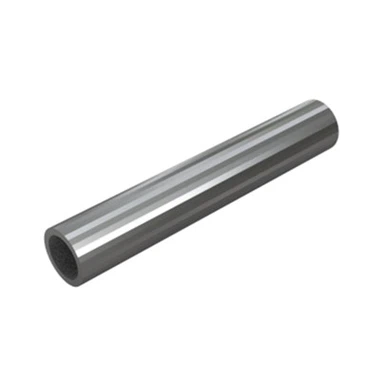
Additionally, thermal effects during extrusion may cause overheating of the material's microstructure, compromising the final product's quality. Therefore, selecting reasonable extrusion parameters is crucial. Based on previous development experience, the billets were heated to 950°C, and an extrusion ratio of 3–10 and extrusion speeds of 50–120 mm/s were adopted to minimize thermal effects and ensure good surface quality and mechanical properties. The extrusion deformation diagram is shown in Figure 1, and the final extruded pipe is shown in Figure 2.
2. Results and Discussion
2.1 Surface and Dimensional Accuracy
The surface quality of the extruded pipe was good, and the straightness was satisfactory. After machining, the dimensions met the design specifications.
2.2 Microstructure
Extrusion was performed at 40–50°C below the phase transition point in the α+β region. By controlling deformation rate and preventing excessive temperature rise during deformation, a typical α+β phase processed structure was achieved. The microstructure showed elongated and compressed grains oriented along the direction of force.
2.3 Mechanical Properties
Room temperature mechanical properties were tested on specimens from as-extruded pipes and after air-cooling annealing at 750°C for 1 hour. The results showed good matching of all mechanical parameters, meeting the design and application requirements.
3. Conclusion
The hot extrusion process, when combined with appropriate process parameters, produced TC4 titanium alloy pipes with excellent microstructure and mechanical properties.
The pipes meet all design specifications and are suitable for use in subsea oil and gas transportation pipelines.